 AVT:
Unsuperivised Learning of Transformation Equivariant
Representations by Autoencoding Variational
Transformations
AVT:
Unsuperivised Learning of Transformation Equivariant
Representations by Autoencoding Variational
Transformations
Guo-Jun Qi
Laboratory for MAchine Perception
and LEarning
(MAPLE)
Abstract: The learning of Transformation-Equivariant Representations (TERs),
which is introduced by Hinton et al., has been considered as a principle to
reveal visual structures under various transformations. It contains the
celebrated Convolutional Neural Networks (CNNs) as a special case that only equivary to the translations. In contrast, we seek to train
TERs for a generic class of transformations and train them in an unsupervised fashion. To this end, we
present a novel principled method by Autoencoding Variational Transformations (AVT), compared with the
conventional approach to autoencoding data. Formally,
given transformed images, the AVT seeks to train the networks by maximizing the
mutual information between the transformations and representations. This ensures
the resultant TERs of individual images contain the intrinsic information about their visual structures that would equivary extricably under various transformations. Technically, we
show that the resultant optimization problem can be efficiently solved by
maximizing a variational lower-bound of the mutual
information. This variational approach introduces a
transformation decoder to approximate the intractable posterior of
transformations, resulting in an autoencoding
architecture with a pair of the representation encoder and the transformation
decoder. Experiments demonstrate the proposed AVT model sets a new record for
the performances on unsupervised tasks, greatly closing the performance gap to
the supervised models.
Transformation Equivariant Representations
In a general
sense, a Transformation Equivariant Representation (TER) is supposed to contain
sufficient information about the visual structures of an individual image such
that a transformation can be predicted from the representations of an original
and transformed image. The criterion of learning a TER has been explored to
train a new paradigm of Auto-Encoding Transformation (AET) [2] rather than data
like in the conventional auto-encoders (see http://maple-lab.net/projects/AET.htm
for more information about AET). In contrast, the proposed AVT seeks to
directly maximize the mutual information between the representation and
transformation. This provides an information-theoretical perspective to train
the TER in a more principled fashion, as well as reveals a direct connection
between the learned representation and the applied transformation.
The transformation
equivariance is an important property to explore in
training the representations, because
1.
It
enforces the representation to encode the most essential visual structures of
images so that the transformation can be decoded from representations before
and after the transformation.
2.
Compared
with the conventional auto-encoder that attempts to reconstruct the input image
in a high-dimensional signal space, decoding transformations is easier since a
transformation often resides in a lower dimensional space with much fewer
degree of freedom. This presents
the learned representations from over-representing images with unnecessary
details, and thus provides more compact features only encoding the most intrinsic structures that equivary to extrinsic
transformations.
Formulations
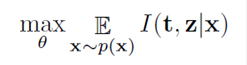
Given a sample x randomly drawn from the data distribution p(x), the AVT seeks to learn its representation z by
maximizing the expected mutual information over p(x)
While it is hard
to directly maximize the above mutual information, a variational
lower bound is derived that is tractably maximize:
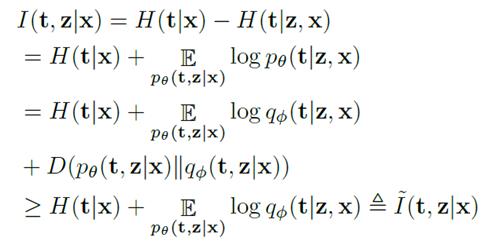
where q(t,z|x) is the
transformation decoder and p(t,z|x) is the TER encoder.
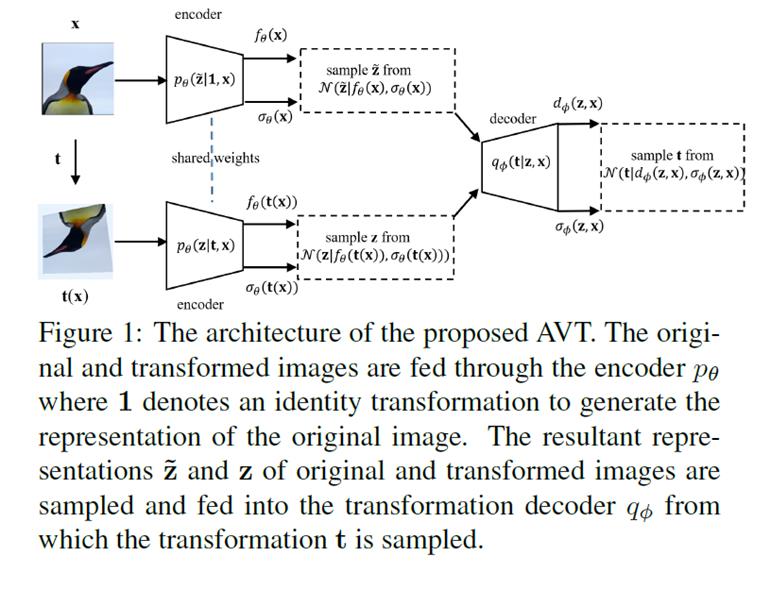
Figure 1
illustrates the architecture of the proposed AVT. For more details about how to train AVT,
please refer to [2].
Experiments
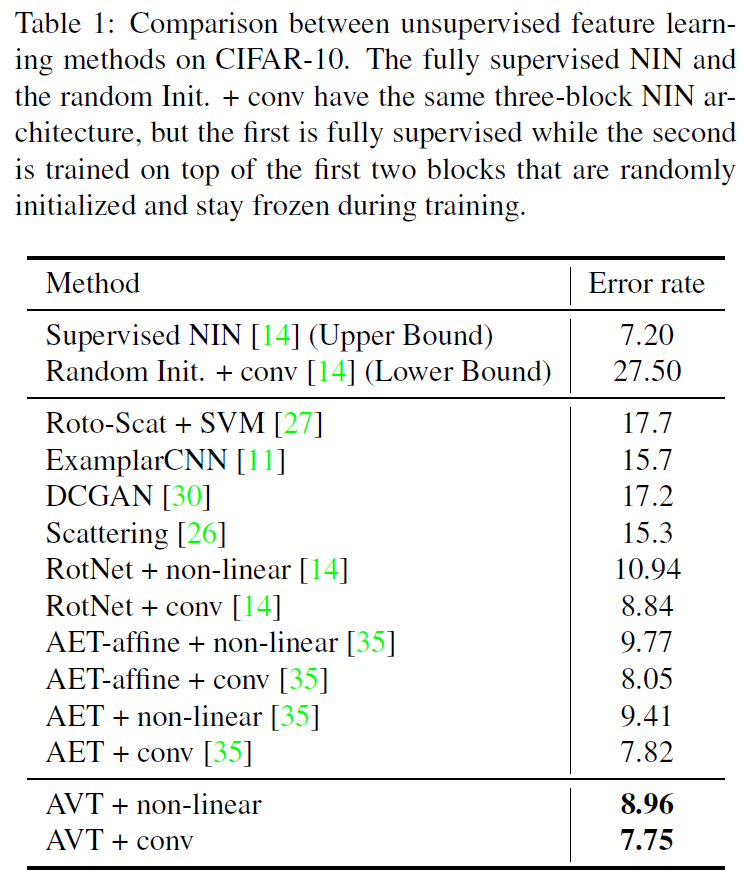
Our results on
CIFAR-10 in Table 1 show the AVT outperforms
the other compared unsupervised models.
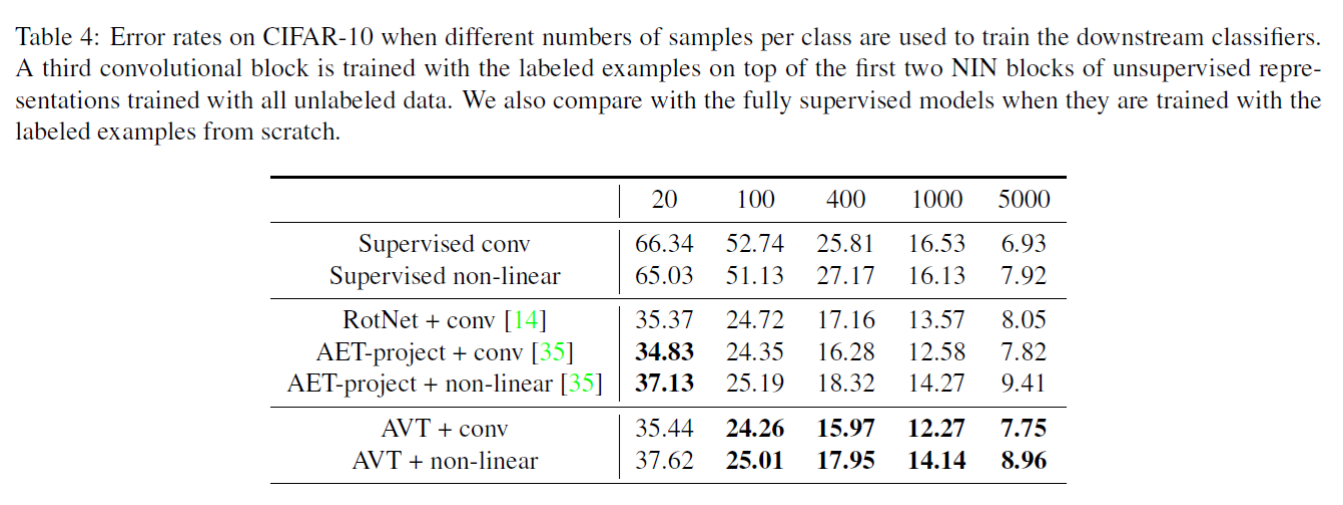
Moreover, Table 4 shows with few number of samples per
class used to train the downstream classifiers, the AVT paradigms still achieve
very competitive accuracies compared with the other methods.
The results on
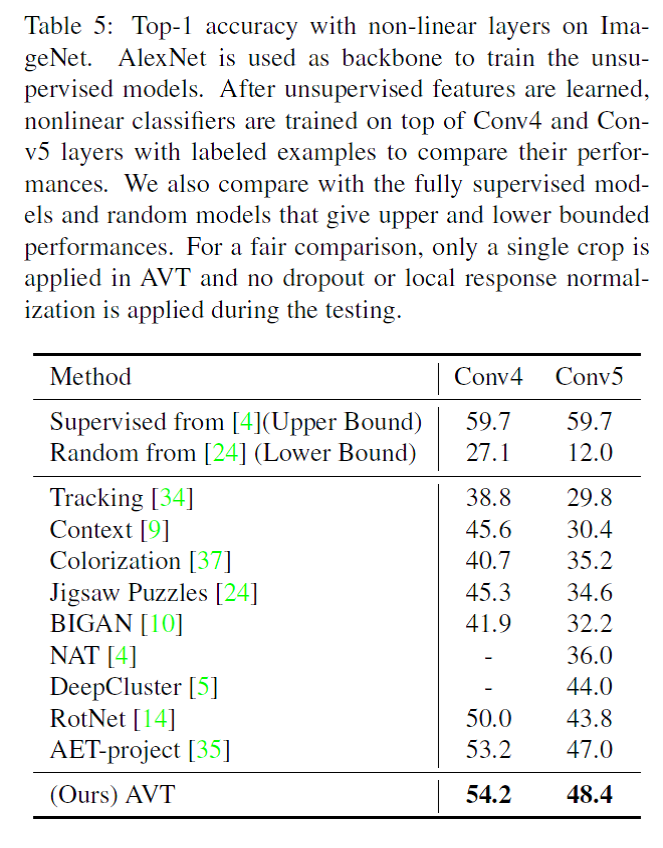
ImageNet in Table 5 also demonstrate
the AVT can greatly close the performance gap with the fully supervised models
(54.2% vs. 59.7% with Conv4 representation and 48.4% vs. 59.7% with Conv5
representation).
More results can
be found in [2].
References
[1] Liheng Zhang, Guo-Jun Qi, Liqiang Wang, Jiebo Luo. AET vs.
AED: Unsupervised Representation Learning by Auto-Encoding Transformations rather
than Data, in Proceedings of IEEE Conference on Computer Vision and Pattern
Recognition (CVPR 2019), Long Beach, CA, June 16th - June 20th, 2019. [pdf]
[2] Guo-Jun Qi, Liheng Zhang, Chang
Wen Chen, Qi Tian. AVT: Unsupervised Learning of Transformation Equivariant
Representations by Autoencoding Variational
Transformations, arXiv:1903.10863 [pdf]
March 27, 2019
© MAPLE Research